


Understanding the Carbon Footprint of Different Stems

Updated: Aug 27
Where to start with creating more sustainable bouquets? The obvious answer is with UK-grown flowers as they must have a lower carbon footprint and therefore result in a lower emission bouquet, right? Well, that’s not always possible when you need year-round flower availability. So, how do you make the most informed choices for a lower carbon bouquet?
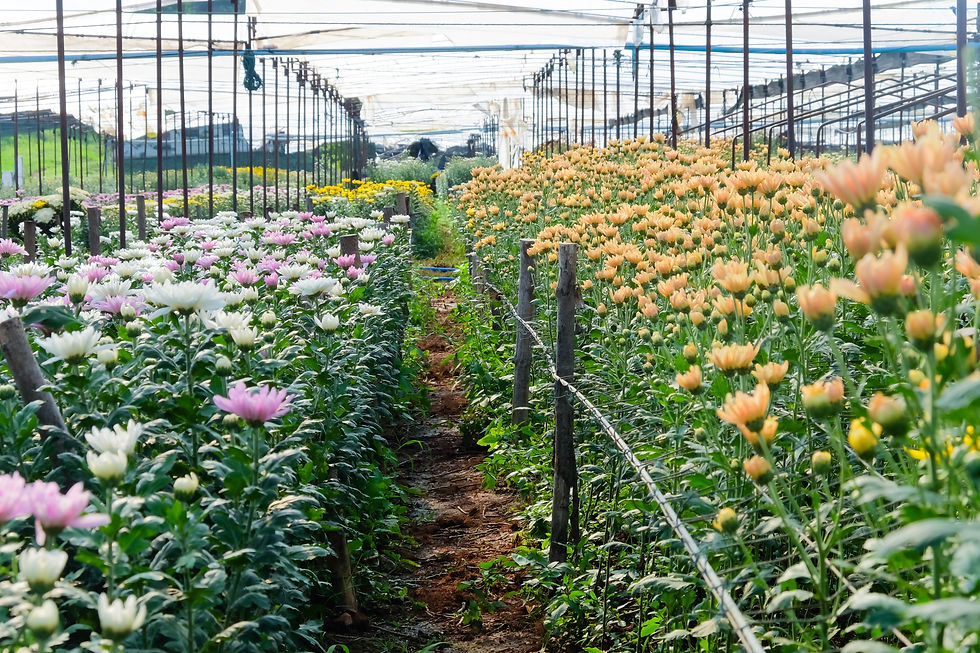
Key Research Findings
There’s actually very little research into the carbon emissions of specific flower and foliage species, suggesting that this is really quite difficult to measure in isolation. What has been researched more extensively is the sum total of emissions resulting from growing and transporting different flowers. This gives an indication of the carbon footprint created from field to florist. Unsurprisingly, research findings indicate that carbon emissions are impacted mainly by where the flower is grown and how its transported.
Research suggests that the biggest drivers of carbon emissions are:
Greenhouse heating and lighting (very high in colder climates).
Air freight transport (extremely carbon‑intensive).
Cold-chain refrigeration and storage.
Fertilisers (nitrous oxide emissions).
Taking all of these into account, one UK life cycle assessment study, comparing commonly used flowers, identified the stems with the highest carbon emissions as:
Dutch lilies – energy-intensive greenhouse production.
Kenyan gypsophila – lightweight so often air-freighted long distances.
Dutch roses – high production inputs, a long cold chain and often air freighted.
Kenyan roses – high production inputs, a long cold chain and often air freighted.
Lower-emission flowers (all UK grown) were identified as seasonal, field-grown stems:
Snapdragons
Alstroemeria
Sunflowers
Dahlias
Lilies (grown outdoors or in low-input systems).
The obvious conclusion from all of this is that the same species (e.g. lilies) can have a high or low carbon footprint, depending on the production methods. Overall, greenhouse-dependent flowers such as lilies and roses rank higher in the carbon emissions league table.

Roses are the most researched flower in terms of carbon emissions. Comparing Dutch-grown and Kenyan-grown roses, it has been estimated that Kenyan-grown, air-freighted roses actually have a lower overall carbon footprint than Dutch greenhouse-grown roses, as the impact of heating the greenhouses results in much higher total emissions. This indicates that heating can outweigh international air transport in some cases. The key drivers for lower overall emissions are:
Outdoor production (no heating).
Shorter supply chains.
Less refrigeration.
Even though production methods dominate emissions, other variables still matter, such as the growth requirements of different species, their stem characteristics and vase life:
Growth requirements
Tropical ornamentals are often greenhouse-reliant in Europe.
Temperate seasonal flowers can be grown outdoors.
Stem characteristics
Heavy or delicate flowers need more packaging and use more cold-chain energy.
Vase life
Short-lived flowers result in more waste and higher lifecycle emissions per use.
What does this all mean for florists?
The same flowers can vary hugely in their carbon footprint, for example, with UK field-grown lilies having a low impact and Dutch heated greenhouse lilies having among the highest impact. So the production method matters. For sustainable floristry, carbon emissions reductions come mainly from:
Seasonal sourcing (the biggest win).
Minimising the use of heated greenhouse imports.
Reducing reliance on roses and lilies out of season.
Information sources: Flowers from the Farm, Ellermann Florist, Gitnux Research, PortaNova, Fairtrade, Charlotte's Floral Design.


Comments