


An Introduction to Wiring Flowers

Being able to wire flowers and foliage is an essential skill that every florist needs to learn. Alongside that comes an understanding of when wiring is needed, how to wire and which gauge is the most suitable.

Contents
Why Wire Flowers?
Broadly speaking, wiring is for two reasons, to either support and/or be able to control flower and plant material.
Wiring for Support
Support wiring covers anchoring material into different mediums such as moss or foam and using wire to strengthen stems, foliage and flowers.
Example: Inserting a wire into a soft stemmed flower, such as a Hyacinth, to strengthen the stem and support the flower head.

Wiring for Control
Wiring for control gives the means of manipulation so that flower and plant material can be moved into different positions depending on the design.
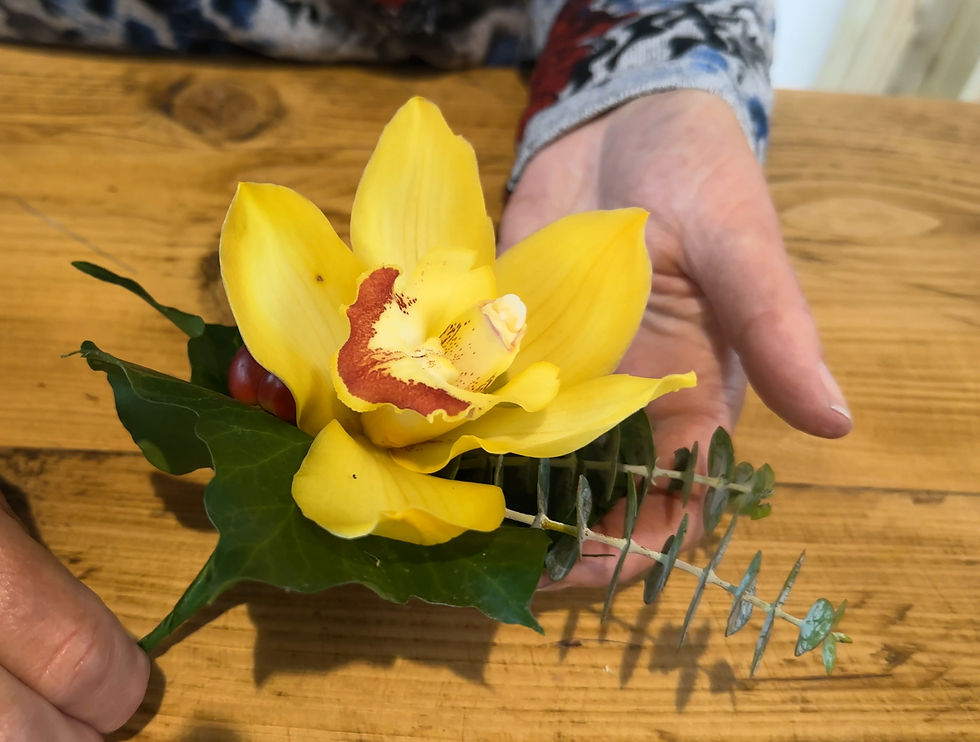
Example: Wiring a Galax leaf for a buttonhole which can then be angled in the necessary direction.
Choosing the Right Wires for your Flowers
Stub or blue annealed wires are of a heavier gauge and are primarily used for support. Sold by weight, typically in packs of 2.5kg, the most practical gauges to stock are .90mm and .71mm, in lengths from 18cm to 50cm.
Annealed wire is metal wire that has been heated and then cooled slowly to reduce its hardness and increase its flexibility
The galvanised silver or rose wire is lighter and commonly used in more delicate work such as headdresses, buttonholes and other bridal designs. These come in shorter lengths, usually 18cm with weights of .37, .38 or .46mm.
Galvanised wire is a strong steel wire coated with a protective layer of zinc to prevent rust and corrosion

Green Wires
These are stub wires that have been covered in green lacquer or plastic. They are useful when the wire will be on show, as it will blend into the design.
Flower Wiring Do’s and Don’ts
Don’t wire unless it’s necessary, wiring should always be kept to a minimum and be as discreet as possible.
Do make sure that you choose the right gauge of wire for the job, if it’s too heavy, the material will break, too light it will be ineffectual.
Do use the correct length of wire to save wastage.
Wiring Do's | Wiring Don'ts |
Make sure you choose the right gauge | Don't wire unless it's necessary |
Use the correct length | Don't leave wire unfinished |
It’s important to make sure that all wires are finished off safely, either with tape or being folded back on themselves to avoid injury.
On that note, remember that the ends of wires are very sharp, so never have your finger directly underneath where you are going to insert a wire. From experience, this hurts!
Frequently Asked Questions
Why do florists wire flowers?
Florists wire flowers to provide additional support or to control the position of flowers and foliage within a design. Wiring can help strengthen delicate stems and make materials easier to shape.
What wire is best for buttonholes?
Lighter galvanised silver or rose wires are commonly used for buttonholes and other delicate bridal work because they are flexible and discreet.
Can all flowers be wired?
Most flowers can be wired if necessary, but wiring should only be used when needed. Good floristry practice is to keep wiring to a minimum and make it as discreet as possible.
How do I choose the right wire gauge?
The wire should be strong enough to support the material without damaging it. A wire that is too thick may break stems, while one that is too thin may not provide adequate support.
Is wiring flowers safe?
Yes, but care should always be taken when handling wire. Wire ends can be sharp, so they should be taped or folded back to prevent injury.

Su Whale is a florist and freelance writer with over Thirty years' experience in the floristry industry. She is the author and publisher of three best-selling books: Cut Flowers, 4th edition (2020) Cut Foliage, 2nd Edition, (2021) and Houseplants (2019), all bookshelf essentials for the professional florist.




Comments